Written by Mojca Sergo | Updated: July 2026
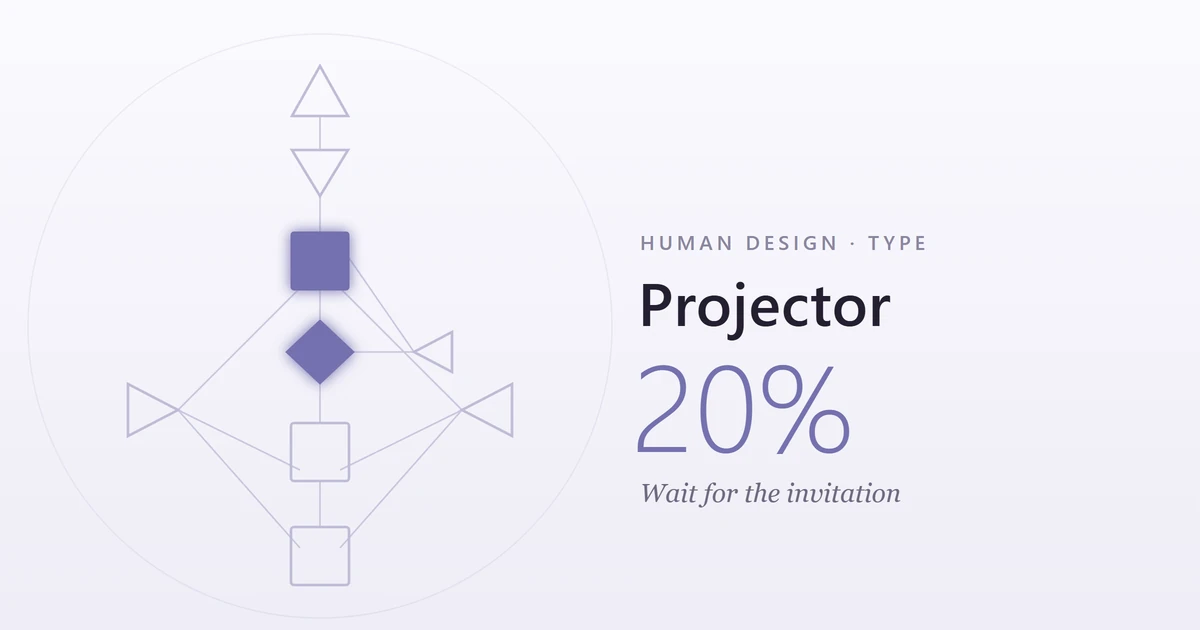
The Projector is one of the five Human Design types – roughly 20% of all people. Unlike the Generator or the Manifesting Generator, it has no continuous energy source. What it has instead is something else: the ability to see systems and people more deeply than anyone.
That’s exactly why the Projector doesn’t operate by the same rules as most of the world. When it tries to work like a Generator – grinding away, hour after hour – it burns out. When it waits for the right opportunity, it becomes an indispensable leader and advisor.
In this article you’ll learn how the Projector works, why recognition is so essential to it, and how to move from constant fatigue to work that truly fills you up.
WHO IS THE PROJECTOR
The Projector has no defined sacral centre, the motor that gives Generators their continuous working energy. Its energy is different: it comes in bursts, not a steady stream. That’s why the Projector wasn’t built for an eight-hour workday, but for focused, deep work in shorter stretches.
What the Projector lacks in stamina, it makes up for in insight. Its aura is focused and absorbing – it naturally notices patterns, dynamics and potential that other types miss. That’s why Projectors so often make natural advisors, mentors and guides.
This gift comes at a cost: the Projector’s aura isn’t inviting in the same way a Generator’s is. It doesn’t draw opportunities in on its own – which is exactly why recognition matters so much more for the Projector than for other types.
STRATEGY: WAIT FOR THE INVITATION
The Projector’s strategy is to wait for the invitation – for the big life decisions: a career role, a relationship, where to live, a business partnership. This isn’t passivity. It’s a precise mechanism that leads the Projector exactly where its insight is genuinely wanted.
The difference in practice:
- Unsolicited advice: the Projector offers an opinion on someone’s project without being asked. → the advice falls on deaf ears, however brilliant it is.
- Invited advice: someone asks the Projector, “What do you see in this?” → the very same insight suddenly becomes valuable and changes the course of the conversation.
Waiting for the invitation doesn’t mean sitting around doing nothing. A Projector living their strategy is visible: they deepen their understanding, share it where there’s room for it, and build the reputation that brings the invitations in the first place.
BITTERNESS AND SUCCESS – THE PROJECTOR’S THERMOMETER
Every Human Design type has its own emotional thermometer. For the Projector, that’s success and bitterness.
Success is a sign the Projector is living their design: recognised for what they know, their insight is wanted, and the work they do doesn’t drain them completely.
Bitterness is a sign of resistance – and here’s the key shift: bitterness isn’t a character flaw to hide. It’s a precise signal that the Projector is giving themselves away somewhere they aren’t recognised. A job where no one ever asks for their insight. A relationship where they give more than they get back.
Projectors who don’t know this often turn the bitterness inward: “I must be too much, that’s why no one values me.” In reality only one thing is wrong – the insight is working somewhere it was never invited.
WHAT IS A “REAL” INVITATION
Not every question counts as an invitation in the Human Design sense. A polite “how are you?” isn’t the same as genuine interest in the Projector’s insight.
You recognise a real invitation by the fact that:
- it’s specific – someone asks you, for you, for exactly what you know,
- it comes from someone who actually has the power to change something (not a random bystander),
- in your body you feel openness, not pressure or obligation,
- there’s room afterward for an honest answer – including “no, thank you.”
The Projector can actively create the conditions for invitations – through visibility, by clearly communicating what they know, by choosing environments where their insight is valued. This isn’t passive waiting. It’s preparing the ground.
COMMON CHALLENGES FOR THE PROJECTOR
- Working like a Generator. An eight-hour workday, every day, without a break – the Projector’s body simply isn’t built to sustain that. The result is chronic exhaustion that no amount of rest fixes until the actual rhythm of the work changes.
- Offering unsolicited advice. Because the Projector sees things quickly and clearly, staying quiet is hard. But advice no one asked for almost always meets resistance, regardless of how good it is.
- Waiting passively. A misunderstood version of the Projector’s strategy becomes an excuse to stay home and do nothing. The real strategy calls for visibility and actively building a reputation – waiting is active, not absent.
- Underestimating their own insight. Because the Projector’s perception comes without effort, they often undervalue it – assuming it’s “obvious to everyone,” when it isn’t.
If you recognise yourself in several of these, nothing is wrong with you. These are standard patterns of a conditioned Projector, and they dissolve through experimenting, not through willpower.
THE PROJECTOR AND LEADERSHIP
Of all the types, Projectors are the most naturally suited to leadership – not leadership through command, but leadership through insight. They see where a team is losing energy, where an organisation is only pretending to function, and what would actually move it forward.
That’s exactly why a Projector thrives as an advisor, mentor or leader – provided they’re invited into that role and recognised for it. A Projector placed at the top without ever being given real authority quickly ends up in bitterness: seeing the solutions, but with no one listening.
You can read more about how leadership differs by energy type in the Leadership portal – one of six portals of self-knowledge within the Magic Leader® system.
ARE YOU A PROJECTOR? HERE’S HOW TO CHECK
Your type can’t be determined with a questionnaire – it’s calculated from your date, time and place of birth. But you can get a sense of it: do you see people and systems down to the smallest detail, yet no one ever asks? Are you often exhausted after an “ordinary” workday, even though the work wasn’t physically demanding? These are common signs of a Projector.
A reliable answer comes from calculating your chart: calculate your Human Design chart for free – all you need is your date, time and place of birth.
The chart will tell you that you’re a Projector. What that means in your actual life – in work, relationships and leadership – is what the 1:1 Human Design meeting is for. If you’d rather explore the topic within a community first, Magic Circle is a free way in.
FREQUENTLY ASKED QUESTIONS ABOUT THE PROJECTOR
What does it mean to be a Projector in Human Design?
The Projector is the energy type with no defined sacral centre – it has no continuous source of working energy, but it does have a gift for deep insight into people and systems. It makes up roughly 20% of the population. Its strategy is to wait for the invitation, since its insight works best when it’s wanted and recognised.
Why does the Projector need to wait for an invitation?
Because the Projector’s aura isn’t open and inviting the way a Generator’s is, opportunities don’t come to them on their own. Unsolicited advice, however good, tends to meet resistance. Invited advice turns that same insight into something valued and welcome.
Why are Projectors often exhausted?
Because they often work on a schedule built for Generators – eight hours a day, without a break. The Projector’s energy comes in bursts, not a steady stream, so long workdays without real rest wear them out physically, no matter how interesting the work is.
Does waiting for the invitation mean the Projector has to stay home?
No. A Projector living their strategy is visible and active: they build understanding, share their insight where there’s room for it, and in doing so create the conditions for invitations to arrive in the first place. Waiting means not forcing yourself in, not being absent.
How do I know if I’m a Projector?
By calculating your chart from your date, time and place of birth – at magic-leader.com the calculation is free. The chart shows your type, strategy and authority; understanding what it means for your actual life is what the 1:1 meeting is for. Learn more about all five types in the overview of Human Design types or the Human Design guide.