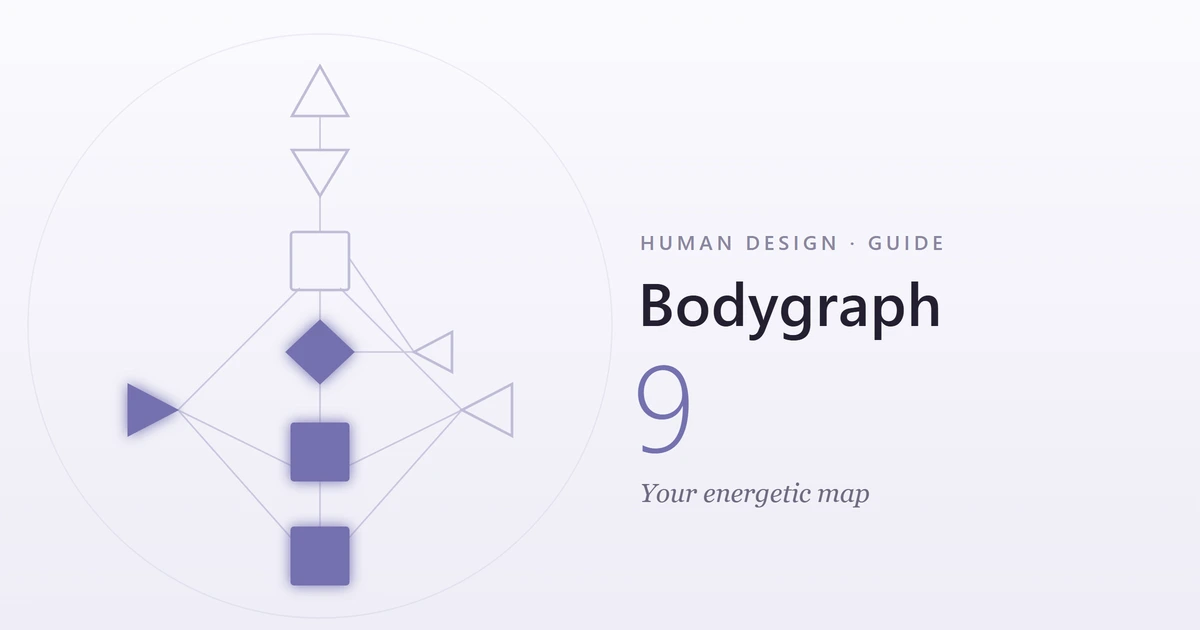
The bodygraph is the first thing you see when you calculate your Human Design chart – a coloured body silhouette dotted with geometric shapes and connecting lines. At first glance it looks like a puzzle. In this post I explain what it’s made of and how to start reading it.
WHAT THE BODYGRAPH IS
The bodygraph is a visual record of your energetic design, calculated from your exact date, time and place of birth. It’s made up of 9 centres, 36 channels and 64 gates – each layer shows a different level of how you’re built.
It isn’t a predictive tool. Think of it more like a map of your energy – where it’s constant, where it’s variable, and where you absorb the most from your surroundings. If you want the bigger picture – where the system comes from and how it all fits together – start with what Human Design is.
THE 9 CENTRES
Centres are geometric shapes laid out across the body silhouette. Each one governs a different area of how you function:
- Head Centre (crown) – inspiration and mental pressure, the questions that keep pushing you forward.
- Ajna Centre – thinking and conceptualising, how you form your opinions.
- Throat Centre – communication and action; where the inner becomes visible and audible.
- G Centre (identity) – direction, identity, love; your sense of who you are and where you’re headed.
- Ego Centre (heart/will) – self-worth, willpower, commitments; also your relationship to material things.
- Sacral Centre – life force and work energy; for Generators and Manifesting Generators, also the inner authority.
- Splenic Centre – instinct, intuition, the immune system; it speaks once, quietly.
- Emotional Centre (solar plexus) – feelings and emotional waves; when undefined, a common source of absorbing other people’s emotions as your own.
- Root Centre – pressure, stress, the drive behind taking action.
DEFINED VS. UNDEFINED CENTRES
On your chart, every centre is either coloured in or white. That difference is probably the single most important piece of information on the entire bodygraph.
Defined centres (coloured) are your constant energy – you’re reliable there, for yourself and for others, and your behaviour is consistent no matter who else is in the room.
Undefined centres (white) are places of openness. You absorb and amplify the energy around you there – which can be a gift (deep empathy, the ability to learn from others) or a trap (taking on other people’s patterns as your own, without realising they were never yours).
Nobody has all nine centres defined. A fully defined chart would mean being completely closed off from the world – that’s not how anyone actually works.
CHANNELS AND GATES
The 64 gates are 64 small, precise themes – each one carries its own meaning, tied to one of the 64 I Ching hexagrams. Gates activate based on the exact position of the planets at your birth (and 88 days before it).
When both gates at either end of the same connection are activated, a channel forms – a solid link between two centres that defines both of them. The 36 possible channels are the building blocks of your chart; which ones are active for you determines which centres are defined and how they connect to each other.
You don’t need to know the individual gates in detail to get started. Understanding the picture at the centre level matters more – channels and gates come into play once you go deeper.
HOW TO READ YOUR CHART
Once you have your bodygraph, start in this order:
- Look at how many centres are coloured in. This tells you your basic energy type – Generator, Projector, Manifestor, Reflector or Manifesting Generator.
- Find your Sacral, Splenic or Ego centre – whichever one (if any) is defined determines your inner authority, your internal compass for decisions.
- Notice the white centres – these are your areas of openness. That’s where there’s the most room to learn, but also the most room to pick up other people’s patterns.
If you’d rather read your chart together with someone who knows the centres and channels and can connect them to your actual life, that’s exactly what a 1:1 Human Design meeting is for.
FREQUENTLY ASKED QUESTIONS ABOUT THE BODYGRAPH
What is the Human Design bodygraph?
The bodygraph is a visual record of your energetic design, calculated from your date, time and place of birth. It’s made up of 9 centres, 36 channels and 64 gates, which together show where your energy is constant and where it’s open to influence from your surroundings.
What does it mean for a centre to be defined?
A defined (coloured) centre is constant energy – you operate consistently there, no matter who you’re with. An undefined (white) centre is a place of openness, where you absorb and amplify other people’s energy.
How many centres does the average person have defined?
It varies widely – nobody has all nine centres defined, and almost nobody has all nine undefined either. The number and pattern of defined centres is unique to each chart.
What are gates and channels in Human Design?
The 64 gates are 64 precise themes tied to the I Ching hexagrams. When both gates at either end of the same connection are activated, a channel forms – a solid link between two centres that defines both of them.
How do I start reading my own chart?
Start by looking at how many centres are coloured in – that shows your type. Then find which centre carries your inner authority. For a reading in the context of your actual life, a 1:1 Human Design meeting is the most reliable next step.